Song Creator · 5 min read
How to Make a Pop Song in Music House
Build a pop brief around a vocal persona, one hook idea, and a clear section plan, then choose the lyric mode and model that fit the draft.
Open Song Creator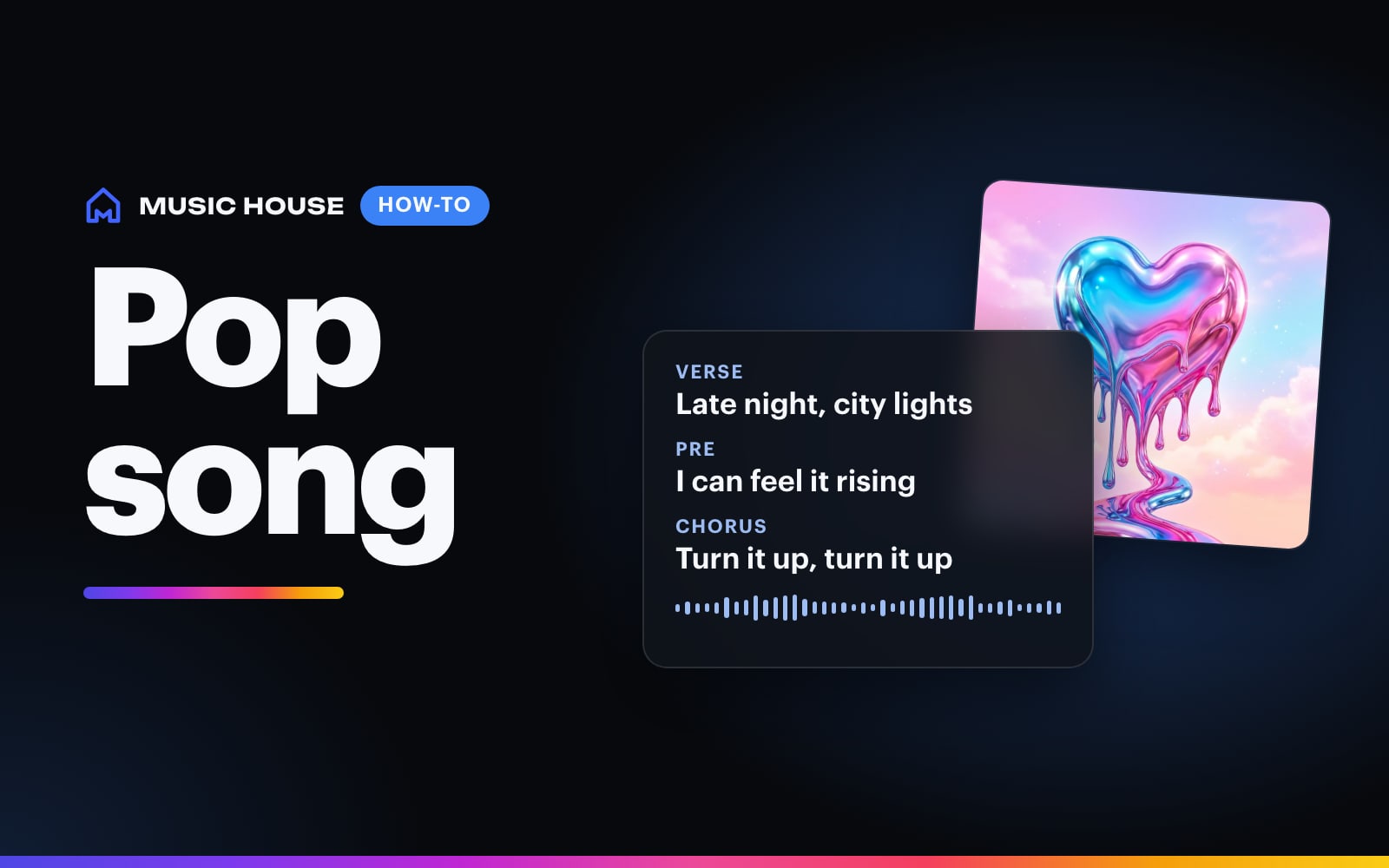
“Catchy upbeat pop song” is too broad to direct a useful result. A better pop brief names the lead voice, the hook behavior, and the path into the chorus.
Start with the singer
Pop is carried by the lead. Describe the range, tone, and attitude:
bright female alto with direct, conversational versesbreathy male tenor that opens into a strong choruslow, close-mic lead with restrained runs
You are describing a performance, not naming a real artist. Concrete vocal direction gives the model more to use than a celebrity reference.
Give the chorus one job
Describe what the hook does:
a sing-along chorus built on long open vowelsa group-vocal answer after each lead linea quiet chorus that grows on the second passa short repeated phrase with a pause before the downbeat
Pick one main behavior. The chorus gets muddy when it has to be intimate, explosive, conversational, and chant-like at the same time.
Add tempo, key, and a section plan
A BPM and key can anchor the production when you know them. If you do not, describe the tempo feel and harmonic mood.
Then give the arrangement a simple route:
intro → verse → pre-chorus → chorus → verse → bridge → final chorus
Music House does not expose separate pitch-correction or Auto-Tune controls. If vocal finish matters, put plain direction in the prompt, such as natural close vocal, clean modern pop vocal, or obvious robotic tuning as an effect. Treat the generated performance as a creative draft and listen to the result instead of assuming a named setting guarantees it.
Pick the lyric mode
- Choose Write for me when you have a story and want Music House to draft the words.
- Choose My lyrics when a hook or lyric sheet must be used.
- Choose Instrumental when you only want the backing track.
For My lyrics, keep the lyric sheet in its own field and use the main prompt for voice, instruments, tempo, and arrangement.
Pick the model by the job
Start with Eleven Music v2 when you want the default engine or a 30-second or 1-minute sketch. Choose MiniMax Music 3 for another full-song interpretation. Choose Lyria 3.5 for a 2-to-4-minute target at a flat 30 credits per take.
One song is the default. Make a single focused take before paying for more variations. The Create button shows the total charge for the selected duration, model, and number of songs.
A prompt shape that works
Use this order:
lead voice + genre and tempo + instruments + hook behavior + section plan + vocal finish
Example:
Bright female alto with playful phrasing, pop/R&B summer anthem at 110 BPM in G major, crisp drums and warm bass, a sing-along chorus on long open vowels, short intro into verse, pre-chorus, big chorus, stripped bridge, and final chorus, clean modern vocal with natural verses.
What weakens the result
- No vocal persona: “A pop song” leaves the lead undefined.
- A chorus made of adjectives: Say what the hook repeats or how it grows.
- Too many arrangement turns: Keep one clear path through the song.
- Lyrics mixed into production direction: Use the dedicated lyrics field when the words matter.
- Four variations before the brief works: Start with one, then change one thing.
Open Song Creator, choose your lyric mode, and make the singer and hook clear before you create.
Try it now
A focused pop-song draft with a clear lead voice, chorus, and arrangement.